
The relationship between quality and quantity
Is the idiom 'quality is better than quantity' a misconception?

When it comes to evaluating a work of art, our brains are designed to catch the best from the better, mostly. Although the quality of an art work could be subjective depending on the subject, there is always a base standard, and it is fairly recognizable if a certain work is of quality or not.
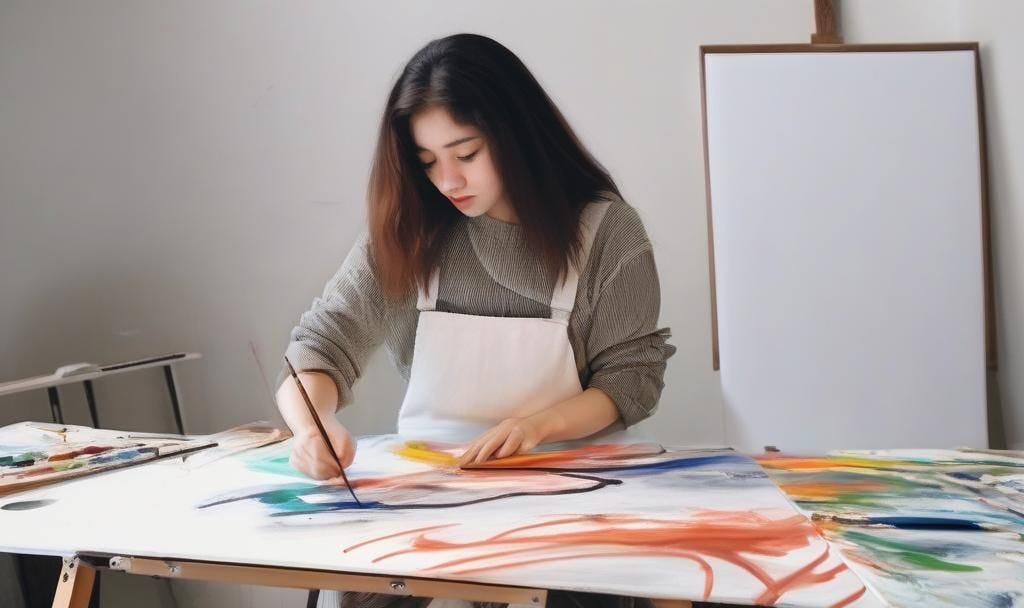
As a young person, I was always overly concerned about the quality of whatever I created, especially if it was something about which people could have different perspectives or opinions, such as a writing piece or a drawing piece.
Long ago, when I was around twenty-two years of age, I was a student at an animation studio. One of the software tools we learned in our course was Adobe Photoshop. My skills in Photoshop were fairly good. One day, we were put to a surprise test. All students were to recreate a digital painting in Photoshop. We received a picture and were required to replicate it using Photoshop's brush and other tools. The goal was to make our digital reproduction of the picture close to identical. The original picture featured a human figure, and capturing the texture of skin digitally is a challenging task, particularly for students.
I clearly remember that no one in the class was able to complete the test at the end of the day. Each student could finish only a part of that picture; some finished the nose and some ears, but none finished the whole picture. No matter how long it took or how small a part of the picture they could recreate, every student was laser-focused on getting the texture right. It was good thinking on their part. After all, the purpose of the test was for the students to apply their skills as best they could.
But I was on a different path altogether. All students gave their utmost effort, but I was unable to even try. That very fortunate day, I had such severe pain on the upper shoulder blade of my left hand that it was impossible for me to sit still in my computer chair, let alone focus on anything. The left hand is a useful limb when it comes to working in Photoshop. We rely on our left hand for numerous shortcuts and frequent keystrokes, and without it, navigating the software becomes challenging. Perhaps our lives wouldn't end if we didn't use our left hand in Photoshop, but on that particular day, the sharp, stabbing pain at the base of my neck paralyzed me, regardless of whether I used my hand or not. Several times in less than ten minutes, I considered contacting my faculty to request permission to leave. However, my hesitation overcame me, and I found myself unable to articulate a single word. I was afraid that it could be perceived as an excuse, and I didn't want to come across that way, so I decided to endure and do what I could.
With the pain now starting to crawl down my spine, I picked up a brush from the toolbox, used the eyedropper tool to pick the nearest color from the original painting, and started dabbing, literally long, thick strokes. Anyone who knows digital painting knows the secret of feather-edged soft brushes with their opacity set to below fifty and— the power of patience. I had left the color opacity of the brush to a full hundred, and my hard-edged brush strokes were creating thick, ugly trails where the character's neck should have been shining. But I had neither the patience nor a calm mind to maneuver through such specificities, as I just wanted to get done with it.
After what seemed like an eternity, the exam period was finally over. Before leaving, I had the chance to glimpse at the work of a few students who were nearby. Everyone had completed a minuscule portion of the picture, but their work was undoubtedly superior to mine. I was the only student whose character had the biggest proportion covered—neck and face (long, thick strokes made it easy, really). While I was about to rush home and address my painfully killing problem, I overheard feedback on my obviously screwed up work. One boy sniggered, "I believe in quantity more than quality." It didn’t really affect my ringing head at that moment, and I just disappeared.
But on a later contemplation, and at a later stage in life while I was reading a wonderful book “Stumbling upon Happiness” by psychiatrist Dr. David Gilbert, I discovered a fascinating relationship between quality and quantity of a work produced. That fellow student’s taunt in my past seemed like it rooted from our belief that if we care about quantity of a work without really paying much attention to the quality, then it would not only produce screwed-up work (like mine), but it would also prove that we are some kind of degenerate artist who doesn’t love quality work like we would love our soulmate.
Is it true, though? That day, if I were trying to get most of the painting done, which I wasn’t really as I was just floating in a painful river and flailing my hands to somehow survive the torture, if I were trying to complete the picture in the given time, should it be considered the wrong way? What if a student puts themselves under such a time constraint every day? They know the skills. And putting themselves under such repeated time constraints might give them the trick on how to cover the most and yet produce something commendable. Is it really possible?
Dr. David Gilbert talks in his book about an interesting experiment where photography students were divided into two groups during a test. One group was told to click as many pictures as they could because their passing criteria was the maximum number of pictures. The other group was told that it doesn’t matter how many pictures they have; they just have to focus on the perfection of a single picture of their choice.
The surprising result (at least I was surprised, and so were the researchers) of this experiment: Students who produced the highest quantity of pictures also produced pictures of superior quality. Their pictures were clearly on par with the students who fretted about the quality of just one. Students were asked how they felt during their test. The students who were randomly clicking reported that they enjoyed the process more because they weren't as concerned about the quality of their pictures, but they still applied their knowledge to produce better pictures. Not worrying about a specific subject also enabled them to explore more. Students who focused on the quality often found themselves pondering and contemplating rather than actually going out and practicing. They were more concerned and self-critical as well.
I learned so many things from this simple yet profound example. When we focus on quality, we stress about perfection, which is highly subjective. This stress becomes counterproductive to our skills.
Apply this experiment to anything—more writing, more songs, more music, more painting. The more we do, the better we get at it without fussing much about the quality. I would add that the inner artist of a person (our unique style) usually comes after we have completed a good number of pieces. Julia Cameron, in her wonderful book “The Artist’s Way” (which changed my life), says that good things start to show up two and a half pages down the line if we keep writing a minimum of three pages every day. This is the power of quantity.
I do not want to ignore the truth, though, that a decrease in the quality of a work can be deliberate as well due to sloth or outright insincerity. However, my perspective differs; it focuses on the misconception that many people, including myself, hold about the importance of quality over quantity. I have learned by now that obsessing over perfectionism is a sign of harming oneself.
If I had painted a dozen digital pictures, irrespective of their quality, before my test that lucky day in my life, then, despite my excruciating pain, I would have been able to focus a little better on the quality without much effort. And that’s what I have experienced many times by now. Perhaps next time, if someone uses the idiom "quality over quantity" inadvertently, you would also be better informed.
Thanks for sharing your experience - and for the interesting thoughts about it.
I think that you are right - there can be too much focus on quality. At some point in time you may find yourself changing your work forever, from one great way to another, without really improving quality. Especially if you work on one small area of it. Then perhaps better move on and work on the rest, and if somehow the lightning strikes and you suddenly see what could still be improved in that small area from before, you can go back and work a bit more on that.
However, a lot of work, especially in art, is not really about the perfect expression - what the viewer or reader enjoy is often more the expression, what you have to say. Or perhaps the strings you pick and the resonance they make in the spectator's mind.
So, moving on and actually producing something - sometimes producing many things - can definitely be better than never really finishing that one corner of the work that you tried to optimize.
But having said that, I must add that I believe we are all kinds of people with all kinds of ideas. Sometimes that hunt for perfection pays off and allows exactly you to deliver exactly what you wanted to deliver. And that it definitely an important part of any artistic work.